
How to Negotiate Medical Bills: A Step-by-Step Guide That Actually Works in 2026
Medical bills are negotiable. This is a fact that hospitals, insurance companies, and billing departments rarely volunteer — but it’s one of the most financially impactful truths in American healthcare. In 2026, with the average hospital stay costing over $15,000 and emergency room visits averaging $2,200, knowing how to negotiate your medical bills isn’t a luxury — it’s a critical financial survival skill.
This guide gives you a proven, step-by-step negotiation process based on how hospital billing actually works — not generic advice, but specific tactics that result in real reductions.
Why Hospitals Negotiate: Understanding the System
Before you can negotiate effectively, you need to understand why hospitals are willing to reduce bills. Hospital pricing is not fixed — it’s a starting point. The “chargemaster” rates (the official list prices) can be 2 to 10 times what insurance companies actually pay for the same services. Hospitals price high because they expect to negotiate down.
When you pay without insurance, you’re often paying chargemaster rates — the highest possible price — while insured patients pay negotiated rates 40–70% lower. This is why your first and most powerful argument is simply: “I’m paying out of pocket and I’d like the same rate you give insurance companies.”
Step 1: Request an Itemized Bill Before You Do Anything Else
Never negotiate from a summary bill. Request a complete itemized bill from the billing department — you are legally entitled to one. Go through every line item and look for:
- Duplicate charges (the same procedure billed twice)
- Upcoding (a more expensive procedure code billed than what was performed)
- Services you don’t remember receiving
- Incorrect patient information (wrong insurance ID, wrong dates)
- “Facility fees” billed separately from physician fees for the same visit
- Charges for items provided at no cost (bandages, gloves, routine supplies often included in room rates)
Medical billing error rates are estimated at 80% by some industry analysts. Even if you find only two or three errors, disputing them establishes that you are a careful, informed patient — which significantly improves your negotiating position. See our dedicated guide on how to spot medical bill errors for a complete checklist.
Step 2: Verify Your Insurance Processed the Claim Correctly
If you have insurance, confirm that: the claim was submitted to your correct insurance plan, your provider was correctly classified as in-network or out-of-network, the diagnosis and procedure codes match what was actually done, and your Explanation of Benefits (EOB) matches the hospital’s bill. Insurance processing errors are common and can result in you being charged for coverage you actually have.
Step 3: Research What the Procedure Actually Costs
Before you call, know what the service should cost. Resources:
- Healthcare Bluebook (healthcarebluebook.com): Shows “fair price” for procedures by zip code based on what insurers actually pay
- FAIR Health Consumer (fairhealthconsumer.org): Shows typical costs for medical procedures in your area
- CMS Hospital Price Transparency: Federal rules now require hospitals to publish their negotiated rates — search “[hospital name] price transparency”
If your bill is $8,000 for a procedure that Healthcare Bluebook says costs $3,200 in your market, you have concrete data for your negotiation — not just a plea for reduction.
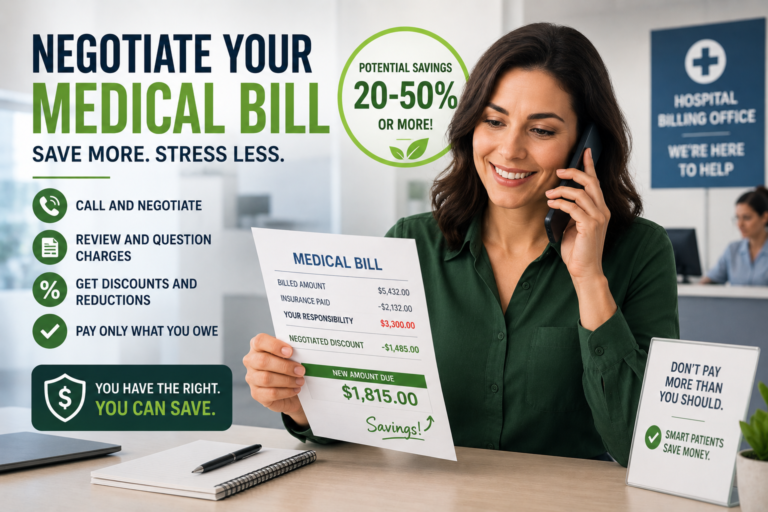
Step 4: Call the Billing Department — This Script Works
Call the hospital billing department (not the collection department if bills have been sent there — go to the source). Use this framework:
“Hi, my name is [NAME] and I’m calling about account number [NUMBER]. I’ve received this bill and I’d like to discuss resolving it. I’m a self-pay patient and I’ve done some research — Healthcare Bluebook shows the fair market rate for this procedure in my area is approximately $[AMOUNT]. I’m prepared to pay promptly if we can agree on a fair price. What’s the best you can do for a prompt cash payment?”
Key elements of effective negotiation: you’ve done homework (intimidating to billing staff), you’re framing this as a business transaction (not a hardship plea — save that for later if needed), and you’re offering prompt payment in exchange for a discount. Billing departments have “prompt pay” discounts they can offer without manager approval — typically 10–20%.
Step 5: Escalate Strategically
If the first representative says they can’t help: “Could you transfer me to your financial counselor or patient advocate?” Hospitals are required by most state laws and accreditation standards to have financial assistance programs. A financial counselor has authority to apply charity care discounts that billing representatives cannot.
If still unsuccessful: request a meeting with the patient financial services director or hospital administrator. Written letters to hospital CEOs sometimes produce remarkable results — hospitals are extremely sensitive to patient relations issues.
Step 6: Apply for Financial Assistance (Charity Care)
Every nonprofit hospital in the United States — which is about 60% of all hospitals — is legally required to have a financial assistance program (charity care) as a condition of their tax-exempt status. These programs can reduce or eliminate bills for qualifying patients, and income limits are often higher than people assume — many programs cover households earning up to 400% of the federal poverty level ($120,000 for a family of four in 2026).
Ask specifically: “Do you have a financial assistance or charity care program, and what are the income limits?” Request the application and submit it with all required documentation. See our complete guide to hospital financial assistance programs for the application process at major hospital systems.
Step 7: Offer a Lump Sum Settlement
If charity care doesn’t apply, offer a lump sum for less than the full amount. Hospitals prefer a certain smaller payment now to an uncertain larger payment over years. A realistic starting offer for an uninsured patient is 30–40% of the billed amount. Counter-offers in the 50–60% range are common outcomes.
Always get the settlement agreement in writing before paying. Specify that the payment “settles the account in full” — not just “partial payment.”
Step 8: Set Up a Payment Plan If Needed
If a lump sum isn’t possible, most hospitals will set up interest-free payment plans. Federal law now limits medical debt interest in many situations. The No Surprises Act (2022) protections also apply in various circumstances. Importantly: hospitals generally cannot report medical debt to credit bureaus until the bill is 365 days past due (as of new CFPB rules). You have time.
Real Example: How This Works in Practice
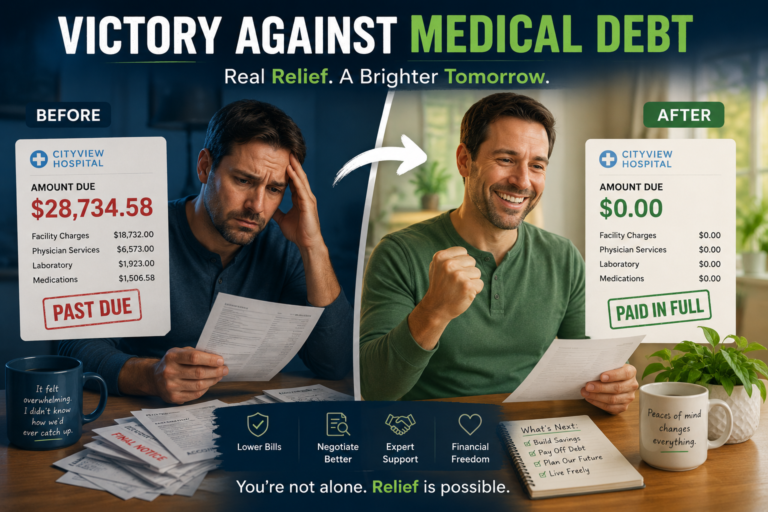
Situation: Sarah, a freelance graphic designer, received a $12,400 ER bill after an appendectomy. Uninsured. Monthly income: $3,800.
Step 1: Requested itemized bill — found $840 in duplicate charges and a $1,200 “facility fee” that her state required to be disclosed upfront (it wasn’t). Disputed both.
Step 2: Healthcare Bluebook showed the fair price for appendectomy ER care in her area: approximately $4,800.
Step 3: Applied for charity care — hospital’s income limit was 300% FPL. Sarah’s income qualified for a 50% reduction.
Step 4: After charity care, adjusted bill: $5,180. Offered $2,800 lump sum settlement. Accepted at $3,100.
Result: $12,400 bill resolved for $3,100 — a 75% reduction.
Frequently Asked Questions
Can the hospital send my bill to collections while I’m negotiating?
Hospitals generally must follow their own financial assistance policies before sending accounts to collections, and new CFPB rules (effective 2026) limit medical debt reporting on credit reports. If a bill goes to collections during an active dispute or financial assistance application, you can challenge the reporting. Document all communications during your negotiation process.
What if the hospital refuses to negotiate?
Escalate to the state insurance commissioner if insurance processing issues exist, your state’s attorney general if the hospital has violated price transparency requirements, or a patient advocate organization. For bills you simply cannot pay, bankruptcy provides additional protection — see our guide on medical debt and collections.
Should I use a medical bill advocate?
Professional medical bill advocates typically charge 25–35% of what they save you — often worthwhile for large bills ($10,000+) where their expertise produces larger reductions. For bills under $5,000, the DIY approach above is typically sufficient and keeps more money in your pocket.
Does negotiating medical bills affect my credit score?
As of 2023, the three major credit bureaus stopped including medical debt under $500 on credit reports. As of 2025 CFPB proposals, medical debt may be removed from credit reports entirely. Negotiating a bill does not itself affect your credit score — only unpaid bills reported after 365 days can impact credit.
Conclusion
Medical bill negotiation is not confrontational — it’s simply participating in a system that fully expects negotiation to occur. Hospitals set chargemaster rates knowing they will be reduced. Every step in this guide — requesting an itemized bill, researching fair prices, applying for charity care, and negotiating a settlement — is legal, ethical, and done successfully by patients every day. The worst outcome is that they say no to a specific tactic, and you try the next one. The best outcome — as Sarah’s example shows — is a 75% reduction on a bill that could have been financially catastrophic. Start with Step 1 today.
Start Fighting Your Medical Bill Today
Download our free Medical Bill Negotiation Script Pack — 5 scripts for every situation.