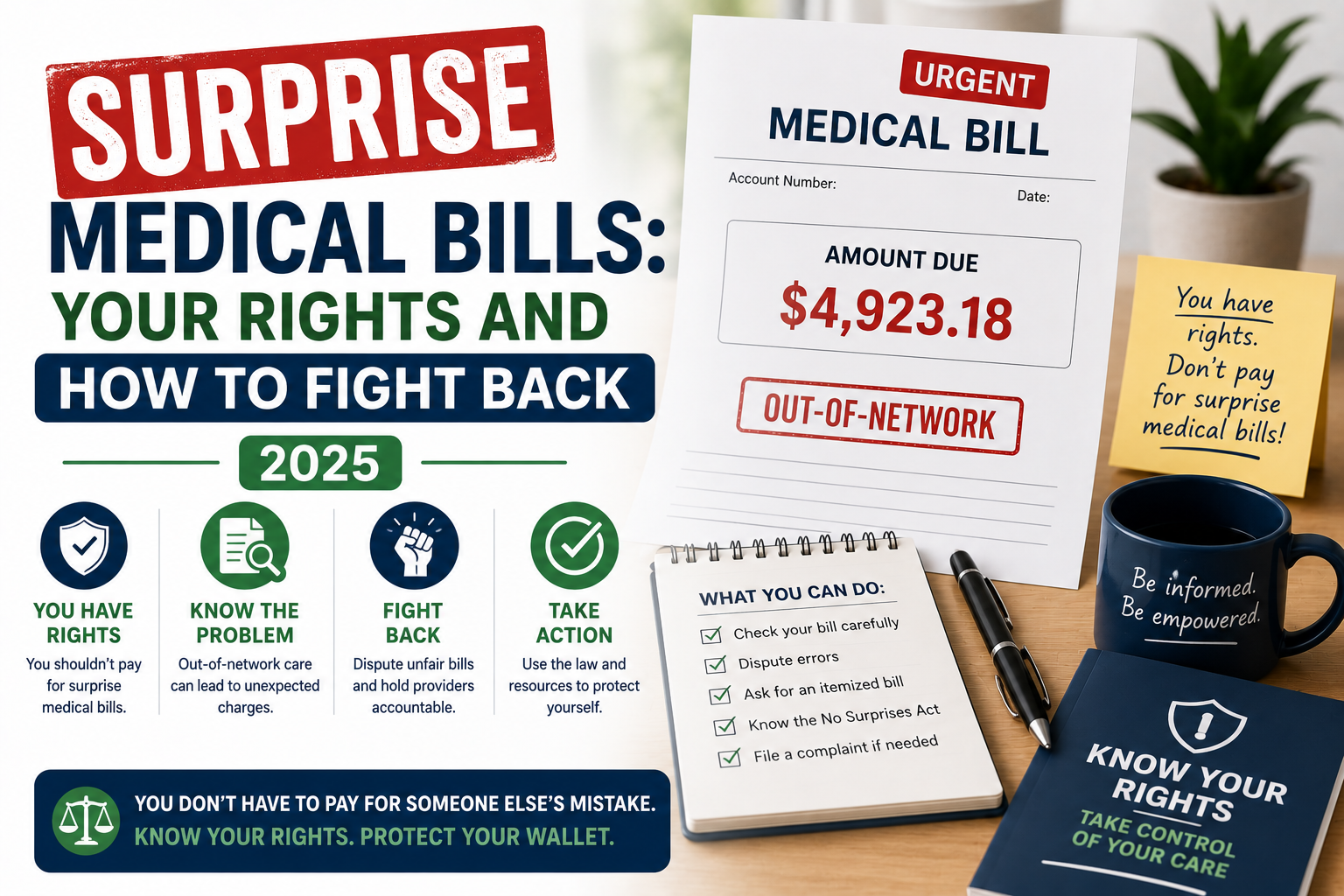
Surprise Medical Bills: Your Rights and How to Fight Back 2025
Jan 2022 — Date the federal No Surprises Act went into full effect for most situations
$0 — Maximum extra you can be charged above in-network rates for covered surprise bills
72 hrs — Advance written notice required before non-emergency out-of-network services
$10,000 — Maximum penalty per violation that providers face under the No Surprises Act
50% — Americans who have received an unexpected medical bill in the past (KFF 2022)
What Is a Surprise Medical Bill?
A surprise medical bill arrives when you receive care from an out-of-network provider without your knowledge or consent — almost always at an in-network facility. The most common scenarios: an in-network hospital assigns an out-of-network anesthesiologist to your surgery; an in-network ER is staffed by an out-of-network physician group; you’re transferred to an out-of-network specialist mid-hospitalization.
Before January 2022, patients had almost no protection against these bills, which could reach tens of thousands of dollars. The federal No Surprises Act changed this dramatically.
What the No Surprises Act Protects
3 Steps to Fight a Surprise Bill
Step 1: Verify it qualifies. Was the facility in-network? Was the service an emergency? If yes to either, the No Surprises Act very likely applies to your situation.
Step 2: Contact the billing department. Say: ‘I believe this bill is subject to the No Surprises Act because [I was treated at an in-network facility / this was emergency care]. I’m requesting that my charges be adjusted to my in-network cost-sharing amount immediately.’
Step 3: File a federal complaint if refused. If the provider refuses to adjust the bill, file a complaint at no-surprises.cms.gov or call 1-800-985-3059. CMS investigates and enforces. Providers face up to $10,000 in penalties per individual violation — this leverage is real and effective.
| Scenario | Are You Protected? | What to Do |
|---|---|---|
| ER visit at any hospital | Yes — in-network rates apply | Request insurer adjust to in-network cost-sharing |
| Surgery at in-network hospital | Yes (if no proper advance notice) | Request billing adjustment, cite No Surprises Act |
| Voluntary out-of-network visit | No | Negotiate directly using the scripts in our other guide |
| Air ambulance transport | Yes — major NSA coverage | Cite NSA immediately — air ambulances were notorious for huge surprise bills |
| Non-emergency with signed consent | Limited | Verify consent form meets exact NSA legal requirements |
State Protections That May Add More Coverage
Over 30 states have enacted their own surprise billing laws, many providing protections beyond the federal No Surprises Act. California, New York, Texas, and Florida have particularly strong state-level laws. Search ‘[your state] surprise medical bill law’ to find your specific state protections — they may cover situations the federal law doesn’t.
Related: How to Negotiate a Medical Bill Down 50% | Medical Billing Errors: How to Find and Dispute Them
Frequently Asked Questions
Does the No Surprises Act apply to uninsured patients?
Partially. Facilities must provide a Good Faith Estimate for scheduled services to uninsured patients before care. If the final bill is $400 or more above the estimate, you can initiate a Patient-Provider Dispute Resolution process through HHS to challenge the overcharge.
What is a Good Faith Estimate under the No Surprises Act?
A written estimate of expected charges for any scheduled service. Uninsured patients must receive one upon request. Insured patients can also request one for their own cost-sharing estimate. Providers must deliver estimates at least 3 business days before scheduled services.
What if the provider says I signed a consent form for out-of-network care?
Review the form carefully. Under the NSA, valid consent requires: written notice at least 72 hours before service, specific disclosure of out-of-network status, a cost estimate, in-network alternatives explicitly offered, and your dated signature. Generic check-in forms or blanket hospital admission consents do not satisfy these legal requirements.
What penalties do providers face for NSA violations?
Up to $10,000 per violation, plus potential removal from federal health programs. These penalties are why simply referencing the No Surprises Act by name when disputing a bill often produces immediate results — providers take it seriously.
Does the NSA cover dental or vision surprise bills?
Not directly. The NSA primarily covers services under group health and individual health insurance plans. However, dental services performed in a hospital setting covered by your health plan (emergency oral surgery, for example) may qualify for NSA protection.
What is the Independent Dispute Resolution (IDR) process?
When insurers and providers cannot agree on the payment rate for a surprise bill claim, they enter federal IDR arbitration. This process occurs between your insurer and the provider — you are not involved. Regardless of the outcome, your cost-sharing remains fixed at in-network rates.
Know Your Rights and Use Them
The No Surprises Act represents one of the most significant patient protection laws enacted in decades. If you received an emergency bill or a bill from an in-network facility with out-of-network providers, you almost certainly have the legal right to pay only in-network rates. Do not pay a surprise bill without first investigating your rights — the complaint process at no-surprises.cms.gov is completely free and can be completed in minutes.