Medical Billing Errors — How to Find and Fix Them (And Get Your Money Back)
If you have received a hospital bill recently, there is a better than even chance that bill contains at least one error. Not a small rounding mistake. A real, significant error that is costing you money you should not have to pay. Research by Medical Billing Advocates of America found that up to 80% of medical bills contain at least one billing error. A study published in the Journal of the American Medical Association (JAMA) found that billing errors add an estimated $68 billion in unnecessary costs to the US healthcare system every year. That is not a typo. Sixty-eight billion dollars. And the vast majority of patients — who receive a bill, feel overwhelmed and simply pay it — never know they were overcharged. This guide gives you everything you need to find billing errors on your own medical bills, understand exactly what each type of error means and fix them — including getting a refund if you have already paid.
Why Medical Billing Errors Are So Common
Medical billing is extraordinarily complex. A single hospital visit can generate dozens of individual charges, each requiring the correct combination of: • CPT codes — 5-digit codes describing each procedure or service performed • ICD codes — diagnosis codes explaining why the procedure was necessary • Revenue codes — codes identifying the type of facility service • Modifier codes — additional codes that change how a procedure is billed • NDC codes — drug codes for medications administered Every one of these codes must be entered correctly by a human being — often under significant time pressure, working with incomplete information from clinical staff, and processing hundreds of claims per day. Errors are not always intentional. Many are genuine mistakes made by overworked billing staff. But regardless of whether an error is intentional or accidental, the financial impact on you is the same — you are charged more than you should be.
The Three Types of Medical Billing Errors
Administrative errors — Wrong patient information, incorrect insurance details, wrong dates. These cause claim denials rather than overcharges and are usually straightforward to fix. Coding errors — Incorrect CPT, ICD or modifier codes. These can either inflate your bill (upcoding) or trigger incorrect insurance denials. These require more careful review to identify. Duplicate or phantom charges — Charges for the same service more than once, or charges for services never rendered. These are the most financially damaging type of error and unfortunately among the most common.
The 12 Most Common Medical Billing Errors
Knowing what to look for is half the battle. Here are the 12 most common medical billing errors found on hospital bills:
Error 1 — Duplicate Charges
The same service, medication or supply billed more than once. This is the single most common billing error. Look for any line item that appears twice with the same or similar description on the same date. Common examples: • Same lab test billed twice on the same day • Same medication listed under two different entries • Operating room time billed in two separate line items
Error 2 — Upcoding
Upcoding means billing for a more expensive version of a service than what was actually provided. This is one of the most financially significant types of errors. Common examples: • A routine outpatient procedure billed as a complex inpatient procedure • A brief consultation billed as a comprehensive evaluation • A simple wound closure billed as complex surgical repair • A standard hospital room billed as an intensive care unit stay
Error 3 — Unbundling
Unbundling means separating procedures that should be billed together as a single package — and billing each component separately at a higher combined total. For example, certain surgical procedures include follow-up care in the standard billing code. Billing the surgery and the follow-up visits separately — when guidelines say they should be bundled — is unbundling.
Error 4 — Services Never Rendered
Charges for procedures, consultations, medications or supplies that were never actually provided during your hospital stay. Common examples: • Physical therapy sessions on days you were not at the hospital or were discharged • Consultations with specialists you never met or who only briefly reviewed your chart • Equipment rental for items never used • Medications listed that you do not remember receiving and have no documentation for
Error 5 — Incorrect Patient Information
Wrong name spelling, incorrect date of birth, wrong insurance ID number or incorrect policy number. These errors cause insurance claim denials and can result in bills being sent to the wrong person or processed under the wrong insurance.
Error 6 — Operating Room Time Errors
Operating room time is typically billed in 15-minute increments and represents one of the highest per-unit costs on any surgical bill. Even a 30-minute discrepancy can mean hundreds or thousands of dollars in overcharges. Always verify that the operating room time billed matches the surgical start and end times documented in your medical records.
Error 7 — Anaesthesia Calculation Errors
Anaesthesia is billed using a complex formula based on base units (for the type of procedure) plus time units (for the duration). Errors in either component — the base unit assignment or the time calculation — can significantly inflate the anaesthesia portion of your bill.
Error 8 — Wrong Diagnosis Code (ICD Error)
If the wrong ICD (International Classification of Diseases) diagnosis code is used, your insurance company may deny the claim on the grounds that the procedure was not medically necessary for the stated diagnosis — even if it was entirely appropriate for your actual condition.
Error 9 — Brand Name vs Generic Medication
If you received a generic medication but were billed for the brand name equivalent, you may have been significantly overcharged. Brand name medications can cost 10 to 100 times more than their generic equivalents.
Error 10 — Personal Items Billed as Medical Supplies
Some hospitals have been found to charge medical rates for basic personal care items — toothbrushes, socks, tissues — bundled into supply charges. These should not appear as individual medical charges.
Error 11 — Incorrect Number of Days or Units
Charges calculated based on the number of days (room charges, nursing care) or the number of units (medications, supplies) are prone to quantity errors. Verify that the number of days matches your actual admission and discharge dates, and that quantities of medications and supplies are consistent with your treatment.
Error 12 — Balance Billing for In-Network Services
If your doctor or facility is in your insurance network, you should only be charged your in-network cost-sharing amount. Being billed for the difference between the provider’s actual charge and the insurance-allowed amount — known as balance billing — is prohibited for in-network providers in most states and under the No Surprises Act for emergency care.
How to Find Errors on Your Medical Bill — Step by Step
Finding billing errors requires a systematic approach. Here is the exact process used by professional medical billing advocates:
Step 1 — Request Your Itemised Bill
You cannot properly check for errors on a summary bill. You need the complete itemised statement that lists every individual charge. Call the hospital billing department and say: “Hello, I would like to request a complete itemised statement of all charges for my account number [X] for services on [date]. I would like every charge listed individually, including the CPT code for each procedure.” Under HIPAA, the hospital is legally required to provide this document. Allow 5 to 10 business days. For a complete guide to requesting your itemised bill, see our article: How to Request an Itemised Medical Bill — Free Script Inside.
Step 2 — Request Your Medical Records
To verify charges you need to compare your bill against what actually happened. Request your complete medical records for the same visit — including nursing notes, medication administration records (MAR), surgical notes and discharge summary. You have a legal right to these records under HIPAA. The hospital may charge a reasonable copying fee.
Step 3 — Request Your Explanation of Benefits (EOB)
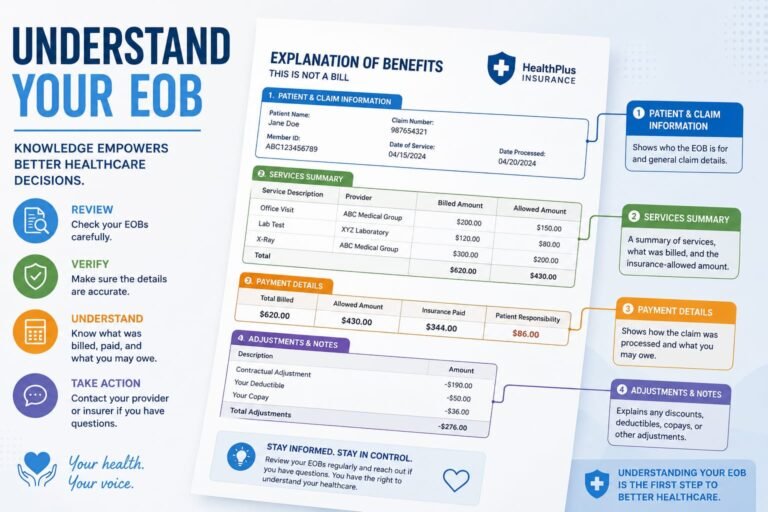
If you have insurance, your EOB shows what was submitted to insurance, what was paid and what you owe. Compare the EOB with your itemised bill — discrepancies between the two are a major red flag.
Step 4 — Set Up Your Review System
Create a simple spreadsheet or list with these columns: • Line item number • Service description • Date of service • Amount charged • CPT code (if shown) • Verified? (yes/no/question) • Notes Go through every line item and mark it as verified, unverified or questionable.
Step 5 — Look Up CPT Codes
For any charge you do not recognise, look up the CPT code using these free resources: • AAPC Code Search — aapc.com/codes • Find-A-Code — findacode.com • CMS CPT Code Lookup — cms.gov Understanding what the code means helps you verify whether the charge is correct and whether the code matches what you recall happening.
Step 6 — Research Fair Market Prices
For procedures you have confirmed were performed, check whether the amount charged is reasonable: • Healthcare Bluebook — healthcarebluebook.com — shows fair market prices by zip code • FAIR Health Consumer — fairhealthconsumer.org — typical costs by CPT code • CMS Hospital Price Transparency Tool — cms.gov/hospital-price-transparency If a charge is significantly above the fair market rate, this may indicate upcoding.
Step 7 — Compare Against Your Medical Records
This is the most thorough but most powerful step. Go through your medical records and cross-reference every charge: • Check medication administration records against medication charges — every medication billed should appear in your MAR with the date, dose and administering nurse • Check nursing notes for equipment and supply usage • Check surgical notes for operating room start and end times • Check the discharge summary for the dates of admission and discharge Any charge that appears on your bill but cannot be found in your medical records is a potential phantom charge that should be disputed.
The Medical Bill Error Checklist — Use This Every Time
Before paying any hospital bill over $500, work through this checklist: ✅ Have I requested and received my complete itemised bill? ✅ Is my name, date of birth and insurance information correct? ✅ Do the admission and discharge dates match my actual hospital stay? ✅ Have I looked up any CPT codes I do not recognise? ✅ Are there any charges that appear more than once for the same service? ✅ Are there any charges for services I do not recall receiving? ✅ Have I verified operating room time against surgical notes? ✅ Have I checked medication quantities against my medication administration records? ✅ Have I verified that no brand name medication was charged when I received generic? ✅ Have I compared charges against fair market prices? ✅ Have I compared my bill against my EOB (if I have insurance)? ✅ Have I checked for any balance billing on in-network services?
How to Fix Medical Billing Errors — Scripts and Steps
Once you have identified potential errors, here is exactly how to get them corrected and — if you have already paid — how to get a refund.
Step 1 — Organise Your Disputed Charges
Create a clear list of every charge you are disputing. For each item include: • The line item number and description from your bill • The amount charged • The reason you believe it is incorrect • What you believe the correct charge should be (if applicable) • The supporting evidence (medical records, fair market price research, etc.) Being organised and specific makes the entire process faster and more effective.
Step 2 — Call the Billing Department
Call during business hours — Tuesday through Thursday between 10am and 2pm produces the best results. Ask to speak with someone who has the authority to review and correct charges. Use this opening script: “Hello, I am calling about account number [X]. I have reviewed my itemised bill carefully and I have identified [number] charges that I believe may be errors. I would like to review these with someone who has the authority to make corrections. Could I please speak with a billing supervisor or patient financial advocate?”
Step 3 — Work Through Each Disputed Charge
For each error, explain clearly and calmly: For a duplicate charge: “On my itemised bill I can see [service description] listed on [date] as line item [X] and again as line item [Y]. This appears to be a duplicate charge. Could you please review and remove the duplicate?” For a service never rendered: “Line item [X] shows a charge for [service description] on [date]. I do not have any record of receiving this service and it does not appear in my medical records. Could you please provide documentation confirming this service was provided, or remove this charge if it cannot be verified?” For an upcoding error: “Line item [X] shows CPT code [number] which I understand represents [more complex service]. Based on my medical records, the service performed was [actual service] which corresponds to CPT code [correct code]. Could you please review this code and correct if necessary?” For an operating room time discrepancy: “My surgical notes show my operation began at [time] and ended at [time] — a total of [actual duration]. My bill shows [billed duration] in the operating room. Could you please correct this discrepancy?”
Step 4 — Document Everything
During and after every call: • Write down the name and employee ID of every person you speak with • Note the date and time of every call • Write down exactly what was agreed • Ask for a reference number or case number for the dispute
Step 5 — Follow Up in Writing
After every significant phone conversation, send a follow-up email or letter confirming what was discussed: “Dear [Name], thank you for our conversation on [date] regarding account number [X]. I am writing to confirm that the following charges are under review for correction: [list each charge with amount]. Please confirm in writing when these corrections have been made and provide a revised statement showing the corrected balance.”
Step 6 — Request a Corrected Bill
Once the billing department has agreed to make corrections, request a new itemised bill reflecting the corrected charges. Do not pay any amount until you have received and reviewed the corrected bill.
Step 7 — Request a Refund If You Already Paid
If you paid before discovering errors, you are still entitled to a refund. Contact the billing department and say: “Hello, I am calling about account number [X]. I recently paid this bill in full but have since reviewed my itemised statement and identified billing errors totalling [amount]. I am requesting a review of these charges and a refund of [amount] that I believe was incorrectly charged. Could you please open a review of my account?” Hospitals are legally required to refund confirmed billing errors. Be persistent — follow up in writing if you do not receive a response within 10 business days.
When the Hospital Refuses to Correct Errors
If the billing department refuses to correct what you believe are genuine errors, escalate through these channels: Step 1 — Ask for the billing supervisor or patient financial advocate. They have more authority than front-line billing staff. Step 2 — File a complaint with your insurance company (if insured) — explain that you believe the bill contains coding errors that affected how the claim was processed. Step 3 — Contact your State Insurance Commissioner if the dispute involves an insurance coverage issue related to the billing error. Step 4 — File a complaint with the Centers for Medicare and Medicaid Services (CMS) at cms.gov if you believe upcoding or fraudulent billing has occurred. Step 5 — Hire a medical billing advocate. Professional advocates work on contingency — typically 25–35% of what they recover for you. If they find $5,000 in errors, they keep $1,250–$1,750. You keep the rest.
Real Examples of Medical Billing Errors Found by Patients
These are real types of billing errors that patients have identified and successfully disputed:
Example 1 — The $3,200 Duplicate Lab Test
A patient in Ohio undergoing cancer treatment noticed that her complete blood count (CBC) test appeared twice on her itemised bill — once under the laboratory department and once under the oncology department. The same test, performed once, had been billed by two different departments. Total error found: $3,200 Resolution: Both departments confirmed the error. The duplicate was removed and a refund was issued within 14 days.
Example 2 — The $4,800 Operating Room Time Discrepancy
A patient in Texas who underwent knee replacement surgery compared his surgical notes (which showed a 2-hour 15-minute operation) with his bill (which showed 3 hours 30 minutes of operating room time). The 75-minute discrepancy, billed at $64 per minute, represented a significant overcharge. Total error found: $4,800 Resolution: The billing department reviewed the surgical notes and corrected the operating room time. The patient received a revised bill reflecting the correction.
Example 3 — The $1,400 Brand Name Medication Error
A patient in Florida reviewing her itemised bill after hip replacement surgery noticed that her pain medication had been billed at the brand name rate. Her medical records confirmed she received the generic equivalent. The difference between the generic and brand name billing was significant. Total error found: $1,400 Resolution: The billing department corrected the medication code and issued a revised statement.
Example 4 — The $2,600 Physical Therapy Phantom Charge
A patient in New York received a bill including 4 physical therapy sessions. She had been discharged from the hospital after 2 days and had attended only 1 physical therapy session before discharge. Three sessions had been billed that never occurred. Total error found: $2,600 Resolution: After comparing the bill against the physical therapy notes in her medical records, the billing department agreed to remove the 3 phantom charges.
Example 5 — The $890 Personal Item Overcharge
A patient reviewing his surgical bill noticed charges for items he had not expected — a “patient comfort kit” at $210, “non-slip socks” at $45 per pair (billed 4 times), and “facial tissue” at $38. These basic personal care items had been billed at inflated medical supply rates. Total error found: $890 Resolution: After the patient questioned these charges, the hospital reduced them to cost price as part of a broader bill negotiation.
Free Tools to Help You Find Medical Billing Errors
These free resources help you verify charges and identify errors: Healthcare Bluebook (healthcarebluebook.com) Look up the fair market price for any procedure by CPT code and zip code. If a charge is significantly above the fair price, it may indicate upcoding or an error. FAIR Health Consumer (fairhealthconsumer.org) Provides typical costs for medical procedures by CPT code and geographic area. Useful for verifying whether charges are within normal ranges. Find-A-Code (findacode.com) Free CPT code lookup. Enter any 5-digit code from your bill to find out exactly what procedure it represents. CMS Hospital Price Transparency (cms.gov/hospital-price-transparency) Federal regulation requires hospitals to publicly post their standard charges. You can compare what your hospital charges for specific procedures against their own published rates. AAPC Code Search (aapc.com/codes) Comprehensive medical code lookup covering CPT, ICD and HCPCS codes. Useful for understanding any code that appears on your bill. Patient Advocate Foundation (patientadvocate.org) Free case management for patients with serious illness. Can help you navigate billing disputes when the amounts are significant or the situation is complex.
What to Do if You Suspect Intentional Fraud
Most medical billing errors are genuine mistakes — not intentional fraud. But if you have evidence suggesting deliberate overbilling, you have additional options: Report to the HHS Office of Inspector General (OIG) at oig.hhs.gov — the federal agency responsible for investigating healthcare fraud. File a False Claims Act complaint if the billing involves Medicare or Medicaid — you may be entitled to a portion of any government recovery as a whistleblower. Contact your State Attorney General’s office — most states have healthcare fraud units that investigate systematic billing fraud. Consult a healthcare attorney — some attorneys take these cases on contingency if the evidence is strong.
Frequently Asked Questions
How long do I have to dispute a medical billing error?
There is no universal deadline for disputing billing errors with hospitals — but acting quickly is always better. For insurance-related disputes, most plans require appeals within 180 days of the denial. For direct billing disputes with the hospital, the sooner you act the better — ideally before paying anything. Even after payment, you can typically dispute errors within 12 months of the original bill date.
What is the difference between a billing error and fraud?
A billing error is an unintentional mistake — a miscoded procedure, a duplicate entry, a calculation error. Fraud is intentional misrepresentation to obtain payment that is not owed. The vast majority of billing issues are errors, not fraud. However, if you find systematic patterns of the same type of overbilling across multiple bills, this may warrant reporting to the OIG.
Do I need medical knowledge to find billing errors?
No. Most billing errors — duplicate charges, incorrect dates, services never rendered — can be identified by any patient willing to review their bill carefully. For more technical errors involving CPT codes and medical terminology, free online tools make code lookup accessible to anyone. Professional medical billing advocates can help with complex cases.
Can I get a refund if I already paid a bill that contained errors?
Yes. Hospitals are legally required to refund confirmed billing errors regardless of when the payment was made. Contact the billing department, present your evidence and formally request a refund. If the hospital refuses to process a refund for a confirmed error, file a complaint with your state Insurance Commissioner or Attorney General.
Will disputing billing errors affect my relationship with my doctor or hospital?
No. Billing disputes are handled by the billing department, which is entirely separate from the clinical team providing your care. Your clinical relationship with your doctor is not affected by billing disputes. Hospitals process billing corrections routinely.
How common are errors in specialist bills versus hospital bills?
Billing errors occur across all types of medical bills — hospital, physician, specialist, laboratory and radiology. However, hospital bills — particularly for inpatient surgery — tend to have the most errors due to their complexity and the number of separate departments involved in generating a single bill.
What if the hospital says the charges are correct but I still believe there is an error?
Request written documentation supporting each disputed charge — specifically, medical records confirming the service was provided and documentation of the basis for the CPT code used. If you believe the error is genuine but the hospital will not correct it, consider hiring a medical billing advocate, filing a complaint with CMS, or consulting a patient rights attorney.
Your Medical Bill Error Audit — Start Today
Do not assume your medical bill is correct simply because it came from a hospital. The evidence strongly suggests it is more likely than not to contain at least one error. Here is your action plan: Step 1: Request your complete itemised bill — use the script in our guide How to Request an Itemised Medical BillStep 2: Request your medical records for the same visit Step 3: Work through the 12-error checklist in this article Step 4: Look up any CPT codes you do not recognise Step 5: Compare charges against fair market prices Step 6: Call the billing department with your list of disputed charges Step 7: Get all corrections confirmed in writing before paying Step 8: If you already paid — request a refund for any confirmed errors The average patient who conducts a thorough medical bill audit finds between $500 and $5,000 in errors. The time investment is typically 2 to 4 hours. That works out to an effective hourly rate of $125 to $2,500 per hour — one of the best uses of your time imaginable. Related guides that will help you take the next steps: • How to Negotiate Medical Bills After Surgery — Save Up to 80% • How to Request an Itemised Medical Bill — Free Script Inside • How to Dispute a Medical Bill With Your Insurance Company • What to Do If You Can’t Pay a Hospital Bill — 6 OptionsMedical and Financial Disclaimer: The information on FightMedicalBill.com is for educational purposes only and does not constitute medical, legal or financial advice. Always consult a qualified professional for advice specific to your situation. Billing regulations and hospital policies vary by state and institution and change regularly.