
No Surprises Act 2026: Your Complete Guide to Protection From Unexpected Medical Bills
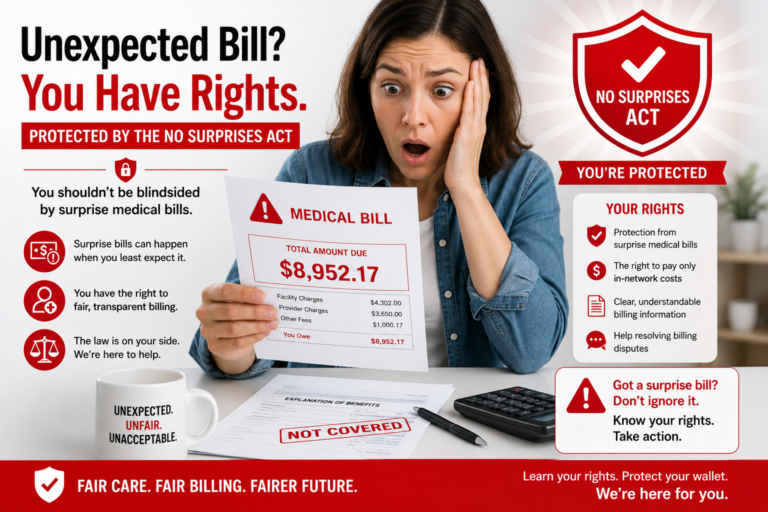
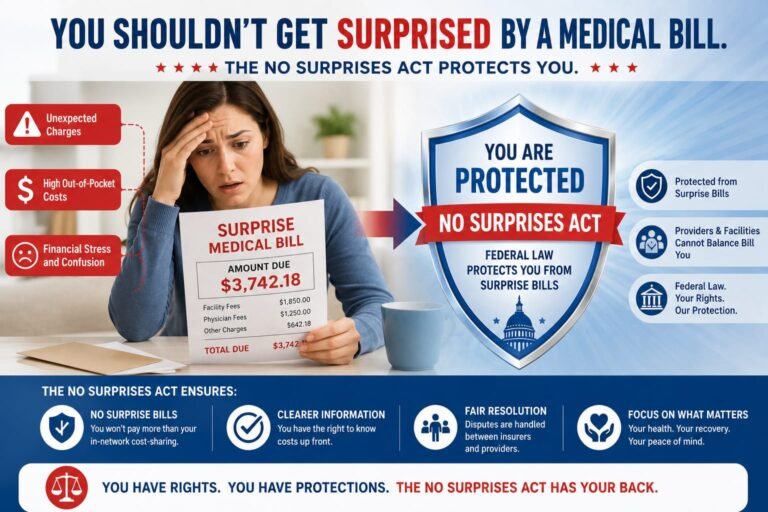
Before January 1, 2022, receiving care at an in-network hospital was no guarantee against receiving a surprise bill from an out-of-network anesthesiologist, radiologist, or emergency room physician who happened to be on call that day. These “surprise bills” — sometimes amounting to tens of thousands of dollars — were legal, common, and financially devastating. The No Surprises Act changed that. Understanding your rights under this law in 2026 can save you from paying bills you legally don’t owe.
What the No Surprises Act Covers
The No Surprises Act provides protections in three primary situations:
Situation 1: Emergency Care
When you receive emergency care at any facility — even a fully out-of-network emergency room — you cannot be billed more than your in-network cost-sharing amount (your deductible, copay, or coinsurance for in-network care). This applies to all emergency services, including facility fees, physician fees, and any ancillary services provided as part of emergency treatment.
Situation 2: Out-of-Network Providers at In-Network Facilities
When you receive non-emergency care at an in-network hospital or ambulatory surgical center, out-of-network providers who treat you without your knowledge or meaningful consent cannot balance bill you beyond your in-network cost-sharing. This specifically covers situations where:
- You chose an in-network facility but an out-of-network physician happened to be assigned
- An anesthesiologist, radiologist, or pathologist involved in your in-network procedure is out-of-network
- An out-of-network specialist consults on your case without your explicit request
Situation 3: Air Ambulance Services
Out-of-network air ambulance services cannot balance bill you beyond in-network cost-sharing. You pay only what you would have paid for an in-network air ambulance.
What the No Surprises Act Does NOT Cover
Understanding the limits is equally important:
- Non-emergency care where you voluntarily chose an out-of-network provider with full knowledge and consent (you signed a valid consent form)
- Ground ambulance services (though many states have separate ground ambulance protections)
- Non-emergency care at out-of-network facilities you knowingly chose
- Out-of-network lab services at facilities with no in-network lab option (varies)
Good Faith Estimate: Your Right Before Treatment
Effective January 2022, providers and facilities are required to give uninsured or self-pay patients a Good Faith Estimate (GFE) of expected charges before scheduled care. The GFE must include estimated costs from all expected providers (not just the facility). If your final bill exceeds the GFE by more than $400, you can dispute the bill through a Patient-Provider Dispute Resolution process. This is an enforceable right — if your bill is more than $400 over the GFE, you have an automatic dispute pathway.
How to Use Your No Surprises Act Protections
Step 1: Identify the Problem
You receive a bill from an out-of-network provider for care at an in-network facility, or for emergency care. The bill is for more than your in-network cost-sharing amount.
Step 2: Write a Dispute Letter to the Provider
Send a letter (certified mail) stating: “I received care at [in-network facility] on [date]. I believe this bill is subject to No Surprises Act protections under 45 CFR Part 149. Under these protections, I am only responsible for my in-network cost-sharing amount of $[amount]. Please adjust my bill accordingly and confirm in writing.”
Step 3: File a Complaint With CMS
If the provider refuses to comply, file a complaint at cms.gov/nosurprises. CMS can investigate and require the provider to refund excess charges. Filing a complaint has been effective — the threat of CMS investigation alone often prompts resolution.
Step 4: Contact Your State Insurance Commissioner
Many states have passed their own surprise billing laws that may offer broader protections than the federal law. Your state insurance commissioner can investigate state law violations simultaneously with the federal CMS complaint.
The Independent Dispute Resolution (IDR) Process
The No Surprises Act created an Independent Dispute Resolution process for providers and insurers to resolve payment disputes — not primarily for patients, but understanding it helps you follow what’s happening with your bill. When your insurer and the out-of-network provider disagree on payment, they can enter IDR. During IDR, the provider cannot collect more than your in-network cost-sharing from you — regardless of the outcome between the provider and insurer.
Real Example
Situation: Michael had a knee surgery at an in-network hospital. His orthopedic surgeon was in-network. Three months later, he received a $4,800 bill from the anesthesiology group, which turned out to be out-of-network. His in-network cost-sharing for the surgery had already been met.
Action: Michael sent a certified letter invoking No Surprises Act protections. The anesthesiology group’s billing department initially pushed back, so he filed a CMS complaint online (15 minutes).
Result: Within 30 days, the anesthesiology group reduced the bill to $0 — Michael’s in-network out-of-pocket for the surgery had been met. The $4,800 bill disappeared.
Frequently Asked Questions
Does the No Surprises Act apply to all health insurance plans?
The federal No Surprises Act applies to most employer-sponsored plans, marketplace plans, and individual insurance. It does NOT apply to short-term health plans, health care sharing ministries, or grandfathered group health plans in some cases. Check your plan type if you’re unsure.
What if I already paid a surprise bill before learning about my rights?
You can still file a complaint and request a refund. The No Surprises Act applies retroactively in the sense that improper bills that were paid can be disputed and refunds requested. The timeline for retroactive complaints is generally within 3 years of payment.
Can a provider ask me to waive my No Surprises Act protections?
For emergency care, no waiver is valid — your protections cannot be waived. For non-emergency care at in-network facilities, providers must give you specific written notice and allow at least 72 hours before the scheduled care to obtain your consent to waive protections. Consents signed at admission during a non-emergency are often not valid waivers.
Conclusion
The No Surprises Act represents one of the most significant patient financial protections passed in decades. If you’ve received a surprise bill from an out-of-network provider for emergency care or care at an in-network facility, there’s a very good chance you have enforceable rights to reduce or eliminate that bill. The process is straightforward — a certified letter, a CMS complaint if needed — and the outcomes are regularly in patients’ favor. Don’t pay a surprise medical bill without first checking whether the No Surprises Act applies. Combined with the negotiation strategies in our medical bill negotiation guide, these protections give you powerful tools against unexpected healthcare costs.
Fight Your Surprise Medical Bill
Free No Surprises Act dispute letter template — ready to send today.