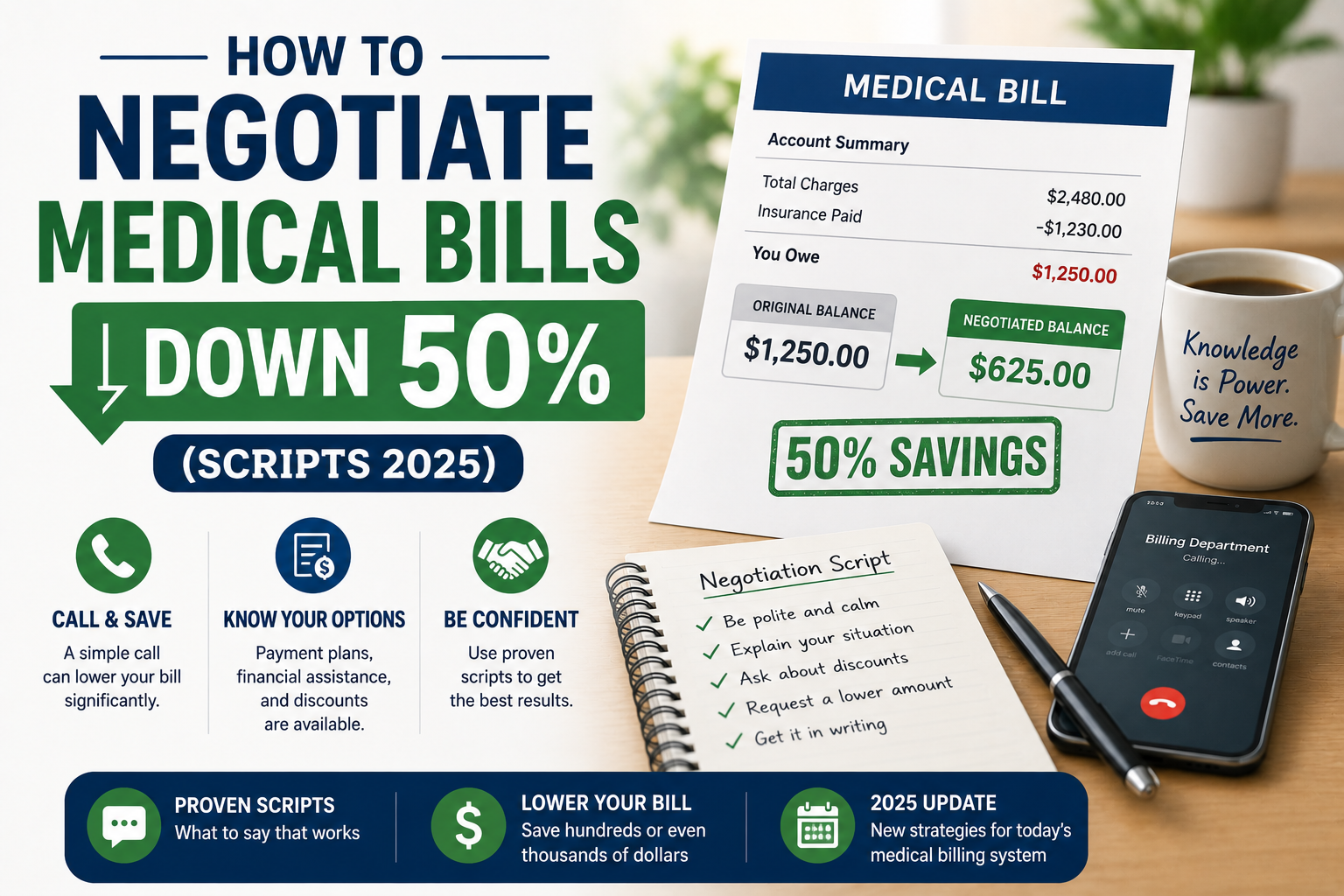
How to Negotiate Medical Bills Down 50% (Scripts 2025)
$220B — Total medical debt held by Americans as of 2023 (CFPB report)
41% — Americans who struggled to pay medical bills in the past year (KFF 2024)
50–80% — Typical discount range achievable through direct hospital negotiation
$0 — Cost to negotiate your own medical bill — no professional advocate required
60% — Of US hospitals that are nonprofit and legally required to offer charity care
Medical Bills Are Negotiable — Here’s the Proof
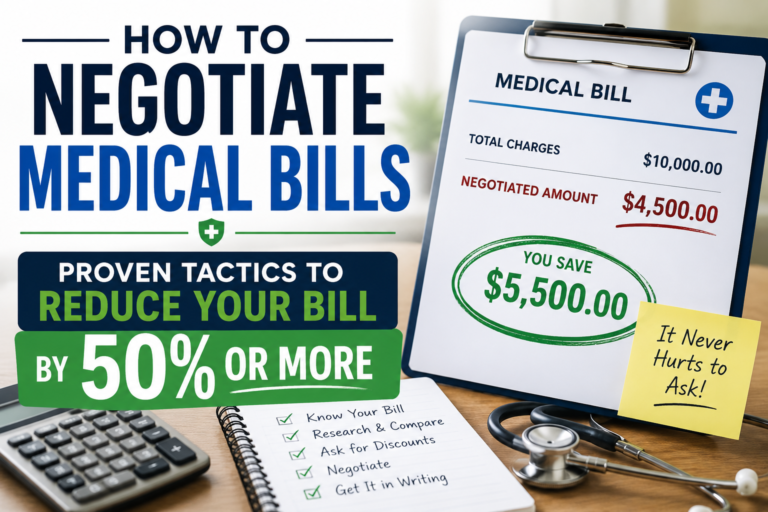
Hospitals routinely accept 40–80 cents on the dollar for medical bills. The ‘chargemaster’ rate — the official billed amount — is a starting price, not a final one. Insurance companies negotiate it down to 30–50% of the original amount. Patients who know how to ask can often achieve similar results through direct negotiation. A 2023 CFPB report found Americans hold $220 billion in medical debt, and most of those people never attempted to negotiate.
Step 1: Get the Itemized Bill First
The summary bill showing one total is useless for negotiation. You need the itemized bill listing every charge, service, code, and date individually. Call billing and say:
Review it carefully — research shows 80% of medical bills contain errors (Medical Billing Advocates of America). Each error you find is a negotiating point or outright removal.
Step 2: Know Your Negotiating Position
The Negotiation Scripts That Actually Work
Script 1 — Financial Hardship Approach:
Script 2 — Medicare Rate Request (Most Powerful):
Script 3 — Charity Care Application:
Negotiation Tactics Compared
| Tactic | How It Works | Typical Result |
|---|---|---|
| Lump sum offer | Offer 40–60% of total paid immediately | 40–60% discount frequently accepted |
| Charity care application | Apply for income-based financial assistance program | 50–100% forgiven for low-income patients |
| Medicare rate request | Ask to be billed at Medicare’s accepted rate | 30–50% reduction typical result |
| Error dispute | Document and dispute each incorrect charge found | Can eliminate individual charges entirely |
| Payment plan | Request $50–$100/month regardless of balance | Prevents collections while negotiating further |
When and How to Escalate
If the first billing rep says no, ask to speak with a patient advocate or patient financial services director — hospitals employ these roles specifically to work out payment solutions. Written requests addressed to the hospital CFO or Patient Services Director often receive more serious consideration than phone calls alone.
Also see: Medical Billing Errors: How to Find and Dispute Them 2025 | Surprise Medical Bills: Your Rights and How to Fight Back
Frequently Asked Questions
Will negotiating my medical bill hurt my credit score?
As of 2025, medical debt under $500 is removed from credit reports. Paid medical debt is no longer reported by any of the three major bureaus. Unpaid medical debt over $500 that’s over a year old can still appear — negotiate before it reaches that stage.
When is the best time to negotiate a medical bill?
As soon as possible after receiving the bill, and before it goes to collections (typically 90–180 days). Your leverage is strongest before collections because hospitals want to avoid paying collection agency fees of 25–35% of what’s collected.
What is hospital charity care exactly?
Under IRS rules, nonprofit hospitals (approximately 60% of US hospitals) must maintain financial assistance policies providing free or deeply discounted care to eligible patients. Income eligibility often extends up to 200–400% of the federal poverty level — that’s a much wider net than most people realize.
Can I negotiate a bill that’s already with a collection agency?
Yes — and you often have more leverage. Collection agencies purchase medical debt for 5–15 cents on the dollar, so accepting 30–50 cents is still profitable for them. Offer 25–30% as your opening position and always get any settlement agreement in writing before making payment.
Should I hire a professional medical bill advocate?
For complex cases or very large bills ($10,000+), a professional medical billing advocate can recover significantly more than their fee (typically 25–35% of savings). APHAdvocates.org maintains a directory of certified advocates. For smaller bills, DIY negotiation using the scripts above is usually sufficient.
What if the hospital refuses to negotiate at all?
Escalate to the Patient Financial Services director. Apply formally for charity care (legally required to process applications). File a complaint with your state’s hospital association. Contact your state attorney general’s consumer protection office. These escalation paths work — hospitals do not want regulatory complaints.
Make the Call This Week
The average medical bill negotiation takes 2–3 phone calls over 1–2 weeks. For a $5,000 bill, a 50% reduction saves $2,500. That’s over $1,000 per hour of your effort. Very few legal, ethical activities pay better. Call the billing department today and start with Script 2 — the Medicare rate request is almost always the most powerful opening move.