How to Read Your Hospital Bill and Spot Errors
Medical billing is one of the most opaque systems in American life. Bills arrive weeks after a visit, filled with codes, abbreviations, and charges that bear little relationship to what actually happened during your care. Most people glance at the total, feel a mixture of shock and helplessness, and either pay it or ignore it hoping it goes away.
Neither response serves you well. Studies consistently find that 49 to 80 percent of medical bills contain at least one error. Those errors are almost always in the hospital’s favor. Learning to read and audit your bill is one of the highest-return financial skills you can develop — a single billing review can save hundreds or thousands of dollars.
Step One: Request the Itemized Bill
The piece of paper you receive in the mail is not really a bill. It is a summary — a simplified version designed to prompt payment rather than to inform you. It will say things like “Emergency Services: $4,200” with no further detail. You cannot review something that vague.
Call the hospital billing department and request a complete itemized statement with CPT codes. CPT stands for Current Procedural Terminology — every medical service has a standardized code. The itemized statement will list every charge line by line with the corresponding code. This is the document you need to audit.
You have a legal right to this document. Hospitals are required to provide it. If a billing representative pushes back or says you do not need it, ask to speak with a supervisor. Persist politely until you have it in hand.
Step Two: Check Every Line Against What Actually Happened
Read the itemized bill while thinking about your actual visit. Make a list of every procedure, test, and service you remember receiving. Then compare your list against the itemized charges.
Look for charges for services you did not receive. This is more common than most people realize. A nurse may have ordered a test and then canceled it, but the billing system recorded the order rather than the cancellation. An attending physician may have consulted on your case briefly without being introduced to you — but a consultation fee appears on your bill.
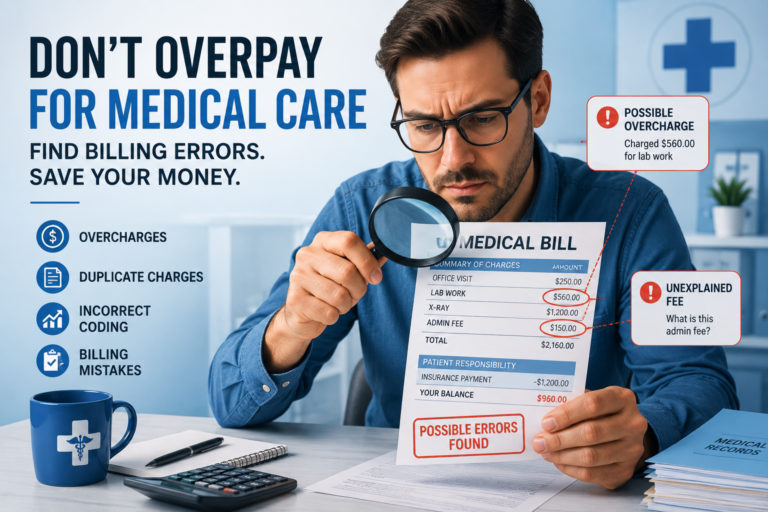
Look for duplicate charges. The same service billed twice appears as two separate line items. Without an itemized statement, duplicates are essentially invisible.
Look for date discrepancies. If you were admitted on a Tuesday and discharged on Thursday, you should not see charges for services rendered on Saturday.
Step Three: Look Up Fair Prices for Every CPT Code
Hospital list prices, called chargemaster rates, bear almost no relationship to what a service actually costs or what insurers actually pay. Hospitals routinely charge 300 to 800 percent of the fair market rate, knowing that insurers will negotiate it down. Uninsured patients and those with high-deductible plans often pay these inflated rates in full.
Go to fairhealthconsumer.org. Enter the CPT code from your bill and your zip code. The tool will show you both the typical insurer-negotiated rate and the typical out-of-pocket rate for that service in your geographic area. This gives you a benchmark to evaluate whether the charge on your bill is reasonable or wildly inflated.
You can also look up facility charges on the hospital’s own website. The No Surprises Act and hospital price transparency rules now require hospitals to publish their standard charges. The published rates are often still inflated, but they establish what the hospital itself claims the service costs.
Common Billing Errors to Look For
Upcoding: Billing for a more expensive procedure than was performed. For example, billing for a complex office visit when you had a routine one, or billing for a private room when you were in a semi-private room. Each service category has multiple billing levels and the hospital chooses which level to assign.
Unbundling: Some services are supposed to be billed as a single bundled charge. When hospitals bill each component separately, the total cost is higher than the bundle would be. This is a common and technically inappropriate billing practice.
Balance billing: If you have insurance, your hospital is supposed to bill your insurer first. If you receive a bill before your insurance has processed your claim, do not pay it — wait for the explanation of benefits (EOB) from your insurer first.
Miscoded diagnoses or procedures: The wrong ICD-10 or CPT code can result in insurance denials or incorrect patient responsibility calculations. This is often an honest mistake with significant financial consequences.
How to Dispute Errors
Once you have identified a specific error, call the billing department with the line-item detail in front of you. Reference the specific charge by line number, CPT code, and date of service. Explain clearly and specifically what the error is. Be polite but direct: “This shows a charge for a CAT scan on the 14th. I did not have a CAT scan during my visit. I would like this charge removed.”
For billing disputes involving your insurance company, also file a complaint with your insurer directly through their member services line. Your insurer has financial interest in correcting overbilling — they pay most of it too.
If informal dispute resolution fails, you have additional options: file a complaint with your state insurance commissioner, contact your state attorney general’s consumer protection office, or ask your employer’s HR department to advocate on your behalf if you are on an employer-sponsored plan. You can also consult a medical billing advocate — a professional who reviews bills on a contingency basis, keeping a percentage of any savings they achieve.
Do Not Pay Before Your Insurance Processes the Claim
This deserves its own section because it is such a common and costly mistake. Many patients receive a bill and pay it promptly, only to later discover their insurance would have covered most or all of it. Once you have paid, recovering that money is difficult.
After any significant medical encounter, wait for the Explanation of Benefits from your insurer. The EOB shows what was billed, what your insurance paid, and what your actual patient responsibility is. Only pay the amount shown on the EOB as your responsibility — and verify that the EOB amount matches the bill before sending a check.